Following his passion: Dr William Clark’s route from an aquatics shop to a PhD
At 30, Dr William Clark returned to education with an HNC in Applied Science at Forth Valley College – a first step that led to a degree, a PhD and a career tackling the climate emergency. Discover how the support of college tutors, a passion for nature and a willingness to try something new helped William turn his curiosity into an inspiring career in science, sustainability and forestry.

Dr William Clark went back to learning at 30, starting with a one-year HNC in Applied Science at Forth Valley College. With the support of teachers and tutors that first step led to a degree, a PhD and a career using nature to tackle the climate emergency.
William’s route into science began with a hobby. He had kept tropical fish for years when a job came up in the aquatics shop of a new garden centre. He was nervous about a public-facing role, but he worked hard, did lots of training and, five years later, was managing the shop. Along the way he met students studying fish biology and aquaculture which sparked his own exploration of a return to education.
A route back into learning
William didn’t have the qualifications to go direct to university so he chose a one-year HNC in Applied Science at Forth Valley College. He admits he hadn’t done well at school and wasn’t sure he was doing the right thing leaving a job he loved.
“The HNC helped me realise learning was fun this time and gave me the confidence I needed to go to university, and the qualification to get in.”
He is quick to share the credit. At Forth Valley College, the tutors “gave me the foundations and confidence for what came next”.
From HNC to PhD
At university William studied cell biology, which is the structural and functional units of life or “how things work”. His final project involved horseshoe crabs, which have blue blood. The aquaculture department had just discovered a fish with blue blood, heard about Williams’ work, and offered him a PhD investigating why.
The fish changes sex, and the blue molecule (biliverdin) helps protect it from damage during the transition. On the day he handed in his thesis, William was offered a post as a Post-Doctoral Research Assistant on an international project searching for new sources of Omega 3 oils. It took him to India, Tanzania and Kenya to study plants, microalgae and seaweeds. He later realised he was working in the Circular Economy and spent five years at Zero Waste Scotland turning food waste back into useful materials like feeds and foods, and plastics and textiles.
Where he is now
William is now a Forest Transport and Innovation Advisor at Scottish Forestry. He manages a fund that reduces the social and environmental impacts of timber transport, runs a shipping initiative avoiding 1,700 tonnes of emissions a year, just finished a three-year pilot of battery electric lorries, and leads the forestry response to major storms, using satellites, machine learning and drones. He also works with researchers and businesses developing new products from wood, from medicines to phone screens.
A big part of his job is encouraging others into the sector, working with schools, colleges and universities.
“It’s such a diverse industry there really is a career for everyone.”
William’s advice
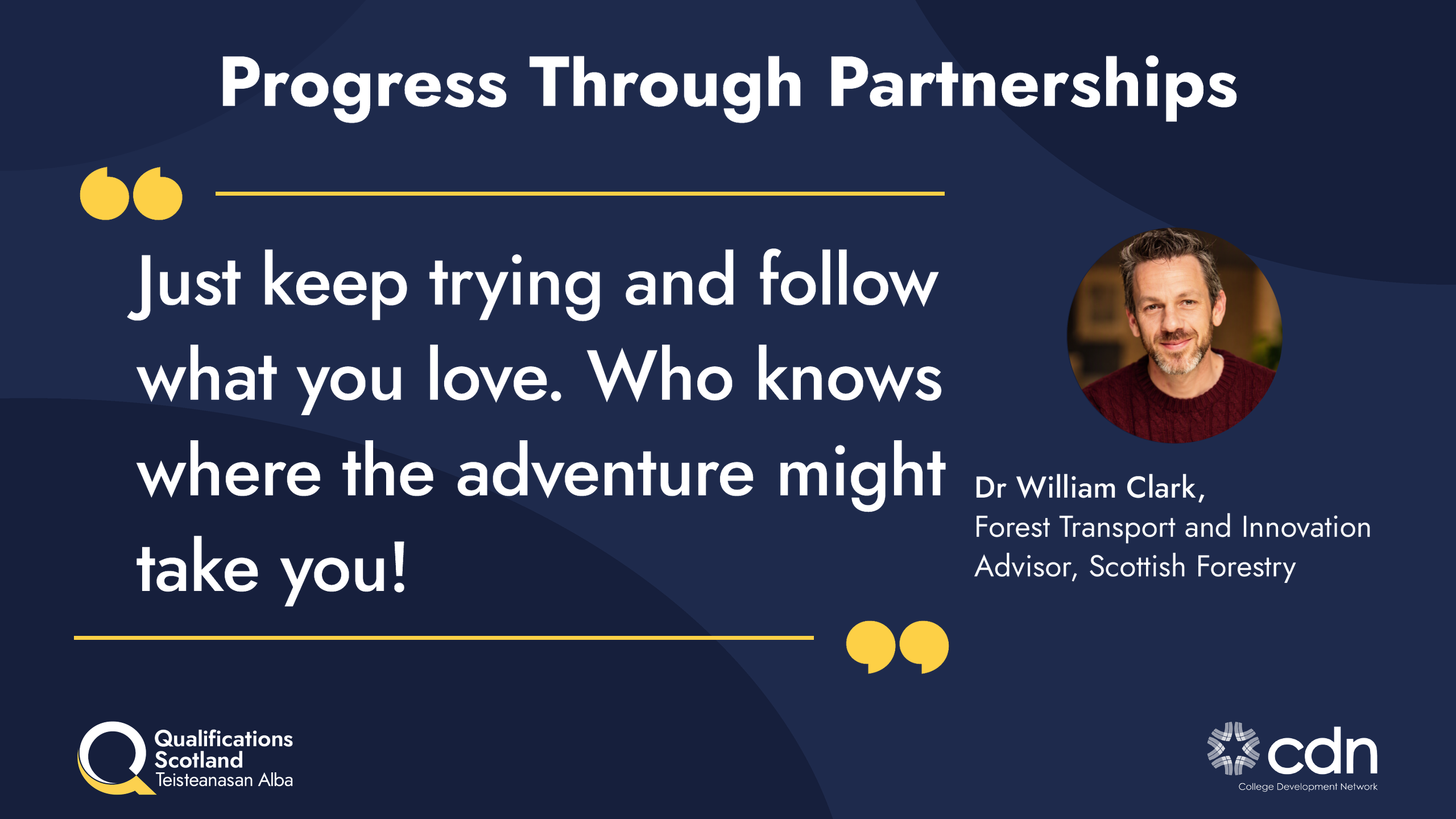
“Do it! This was my second try at university, and I changed course. Be ok if a course isn’t what you thought it was or you find something else and remember failure is always an option – it’s a journey and you’re awesome for trying. The tutors are there and so happy to help to help if you’re willing. Just keep trying and follow what you love. Who knows where the adventure might take you!”
The partnership behind the progress
William’s story is his own, but it took a shop that trained him, a teacher who encouraged his curiosity, college tutors who rebuilt his confidence and a university that offered a way on, alongside all of the incredible friends, students and colleagues he met along the way.
That joined-up system, from school to college to university to work, is what Scotland’s colleges are part of every day, and the SCQF is what shows how each step connects to the next.
Qualifications Scotland is proud to support the work of Scotland’s colleges, and to play our part in routes like William’s.
