Progress through partnership: reflections from the Scottish Training Federation conference
In this blog, Discover key reflections from the Scottish Training Federation conference, where Qualifications Scotland, training providers and policymakers explored how strong partnerships can shape the future of apprenticeships, skills and employability in Scotland.

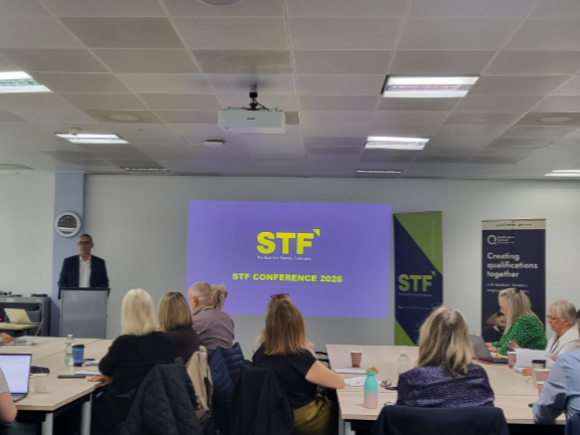
It takes partnership to make progress, and last week’s Scottish Training Federation (STF) conference was a good example of it. Training providers, partners and policymakers came together to talk about the future of apprenticeships and employability in Scotland. Qualifications Scotland was glad to host the event for the third year , and three of our Regional Managers were in attendance – Maureen Wallace, Colette Connolly and Theresa McGowan. Here’s what they took from the day:
One of the highlights of the day for us was the apprentice panel – it was inspiring. The apprentices spoke about their experiences and the benefits of earning while learning. Their passion resonated with the room. Their stories were a reminder of what progress looks like for the learners who are at the heart of what we collectively deliver.
The Minister for Innovation, Technology and Tertiary Education, Alyn Smith, was passionate about the future for education and skills in Scotland, arguing that workplace learning should be the norm. The Minister described employers and training providers as part of the solution and was keen to hear their ideas for improving the apprenticeship programme and offered to meet with them regularly. Progress on a shared priority depends on this kind of ongoing, two-way conversation.
The Skills Development Scotland (SDS) and the Scottish Funding Council (SFC) updates about the transition of apprenticeships were reassuring for all attendees at the conference to hear. From 1 April 2027, SFC will take on responsibility for apprenticeships, as part of its redesign as a funding agency with additional responsibilities under the Scottish Government’s Tertiary Education and Training Act. SDS and the SFC are working closely together to make that transfer smooth and seamless, and hearing that directly from both organisations was an important message of the day. Continuity across partners is what lets progress carry on without interruption.
In his introductory remarks at the start of the day, John Booth, our Chief Strategy Officer, provided the conference attendees with an outline of our ambitions and commitment to putting training provider voices – and the voices of everyone we serve – at the heart of our decision-making.
Qualifications Scotland’s new learner and practitioner interest committees include adult learners and training providers, giving those at the frontline of delivering and taking our qualifications a direct role in advising the Board and shaping its decisions.
These committees are helping us to develop learner and practitioner charters, which will set out what those groups should and can expect from Qualifications Scotland. Colleagues ran a workshop on the day to update training providers on this important work and the feedback received was very useful.
This is a great example of partnership working as it should be, with the people the charters affect helping to shape them.
We are keen to ensure everyone we work with has a say in the development of the charters and together with our other Regional Managers, we will be running similar sessions with employers, training providers and colleges across the country.
Throughout the day, the conversations were positive. There was a real appetite for change and a genuine willingness to engage. The key now is making sure training providers are fully part of the conversation, so apprenticeships, work-based learning and qualifications stay central to Scotland’s future skills landscape. We work closely with STF members and share a common goal of delivering for learners. Our collaboration brings together a range of perspectives, including the invaluable insights of training providers into what learners, employers, the wider workforce and the economy need from qualifications. Strong partnerships, like the one between Qualifications Scotland and STF lead to a more joined-up approach and better outcomes for learners and the economy. Partnerships create new opportunities, strengthen relationships and increase impact by working collectively.
It takes partnership to make progress. We’re proud to stand alongside Scotland’s training providers, and to play our part.